Confirming a plasmid construct by Sanger sequencing for plasmid confirmation is the step most labs rush past — and the step that catches a wrong-orientation insert, a frameshift, or a single-base substitution before it wastes three weeks of downstream work in 2026.
- Sanger sequencing for plasmid confirmation is the standard for single-insert plasmids under 3kb in 2026 — Buy.
- Primer walking beats one read for constructs over 5kb with multiple inserts or repeat regions — Buy.
- Full-plasmid NGS confirmation suits labs running 50+ constructs a month — Consider.
- Restriction digest alone with no sequencing data is a Skip before transfection or glycerol banking.
Why this matters
A colony PCR band or a restriction digest gel tells you the insert is roughly the right size. Neither tells you the sequence is correct — point mutations from PCR-based cloning, off-target ligation, or spontaneous recombination during bacterial propagation don't show up on a gel.
Sanger sequencing for plasmid confirmation closes that gap by reading the actual base order across the insert, the junctions, and any promoter or tag region you care about. Labs running clinical or biotech pipelines in 2026 treat this as a release criterion before a construct moves into transfection, expression, or animal work.
The Yaazh Xenomics lab in Coimbatore runs Sanger and NGS side by side for exactly this reason: some constructs need one clean read, others need a full plasmid map.
Who this is for
This guide is for molecular biology researchers, cloning core facilities, and biotech QC teams confirming plasmid identity before transfection, protein expression, or CRISPR guide validation. If you're managing more than a handful of constructs a month, or your plasmids carry multiple inserts, repeat sequences, or custom tags, the method you pick changes both your turnaround and your confidence in the result.
What to look for in Sanger sequencing for plasmid confirmation
Primer coverage relative to insert size
A single Sanger read reliably covers 700-900 bases past the primer binding site. For an insert under 1kb, one primer at each junction usually closes the sequence. For anything larger, you need enough primers spaced every 600-800 bases to overlap and cover the full construct without gaps.
Phred quality threshold and base-calling accuracy
Q20 (99% base-call accuracy) is the standard threshold for a usable Sanger trace; Q30 pushes that to 99.9%. Low-quality tails near the primer or past 900 bases are normal — what matters is whether the region you actually need to confirm sits inside the high-quality window.
Turnaround time against your experiment timeline
Single-read Sanger turnaround in commercial labs typically runs 24-72 hours; multi-primer walks or full-plasmid confirmation take longer because each primer is a separate reaction. If your next step is transfection scheduled for Thursday, confirm by Tuesday, not the morning of.
Whether both strands get sequenced
Forward-only reads miss errors that a reverse read would catch, especially around homopolymer stretches and GC-rich regions. Double-strand confirmation costs one extra reaction and closes that blind spot — worth it for anything going into a publication or a regulated pipeline.
Chromatogram review and trace file access
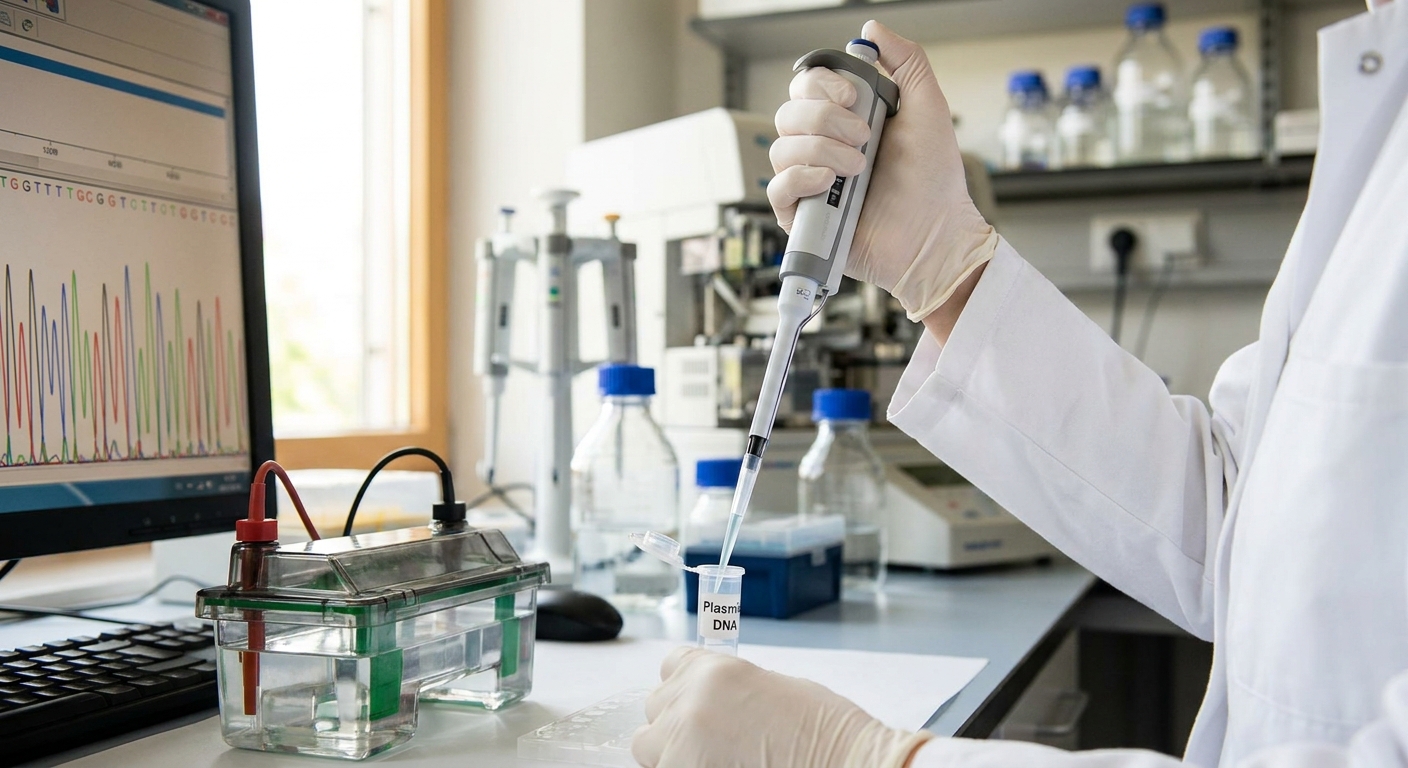
A sequence match report is not the same as reviewing the actual chromatogram. Ambiguous peaks, double peaks from mixed colonies, or dye blobs near the primer site only show up when you (or your lab) look at the .ab1 trace file directly, not just the FASTA output.
Scalability to NGS-based confirmation when plasmid counts scale up
Sanger sequencing for plasmid confirmation stops being efficient once you're past roughly 20-30 constructs a week — at that volume, plate-based NGS confirmation reads every base of every plasmid in one run instead of stacking primer reactions.
Confirm your plasmid construct
Get a Sanger or NGS-based plasmid confirmation quote from the Coimbatore lab.
Top picks for plasmid confirmation
Single-pass Sanger read — the standard pick. One primer, one 700-900 base read, covering the insert junction and immediate flanking sequence. This is the default for straightforward sub-cloning of inserts under 1kb into a well-characterized backbone. Buy for routine confirmation of small, single-insert plasmids.
Primer walking (multi-primer Sanger) — the safe pick for large constructs. Four to six primers spaced across a 5-10kb plasmid, overlapped to close the full sequence with no gaps. This is what catches recombination events or partial deletions that a single read would miss entirely. Buy for anything over 5kb, multi-insert vectors, or repeat-heavy sequences.
Full-plasmid NGS-based confirmation — the high-throughput pick. Instead of stacking individual Sanger reactions, plate-based NGS reads the entire plasmid in one pooled run, which pays off once you're confirming dozens of constructs weekly. It pairs naturally with the kind of NGS panel testing infrastructure a diagnostic lab already runs for clinical panels. Consider if your monthly construct volume is past 50; Skip it for a one-off confirmation of two clones.
Long-read whole-plasmid sequencing — the wildcard. Nanopore-based long-read platforms sequence the entire circular plasmid in a single molecule pass, which resolves repeat regions and large inserts that short reads and primer walking both struggle with. Cost per sample tends to track closer to the figures on a whole genome sequencing cost breakdown than a standard Sanger reaction. Consider for plasmids over 10kb or with tandem repeats; Skip for routine small-vector QC where it adds cost without adding useful information.
Restriction digest alone, no sequencing — the false economy. A digest pattern confirms fragment sizes match a predicted map; it says nothing about point mutations, single-base insertions, or silent recombination events inside the insert. Skip this as a stand-alone confirmation method before any downstream use that matters.
What to avoid
- Colony PCR as your only proof. A PCR band confirms an insert of the right size is present — not that its sequence is correct. Pair it with Sanger data, never substitute it.
- Single-primer confirmation on large or repetitive plasmids. Anything over roughly 3kb with repeat regions needs multiple overlapping primers; a lone read past 900 bases simply stops covering the construct.
- Skipping re-confirmation on "verified" backbone plasmids from a repository. Bacterial propagation introduces mutations over passages — a plasmid confirmed once, three years ago, by someone else, is not the same guarantee in 2026.
“A colony PCR band proves insert size, not insert sequence — only Sanger data proves the clone is what you actually built.”
Verdict comparison
| Method | Coverage | Typical turnaround | Best for | Verdict |
|---|---|---|---|---|
| Single-pass Sanger | 700-900 bases | 24-72 hours | Small single-insert plasmids | Buy |
| Primer walking | Full plasmid, overlapped | 3-5 days | Constructs 5-10kb, multi-insert | Buy |
| Full-plasmid NGS | Full plasmid, deep coverage | Batch-dependent | High-volume confirmation (50+/month) | Consider |
| Long-read whole-plasmid | Full circular molecule, single pass | Batch-dependent | Repeat-heavy or 10kb+ plasmids | Consider |
| Restriction digest only | Fragment size only | Same day | Never as sole confirmation | Skip |
FAQ
What is Sanger sequencing for plasmid confirmation?
It's the process of reading the actual DNA sequence of a cloned plasmid using Sanger chemistry to confirm the insert, orientation, and junctions match the intended design. A single read typically covers 700-900 bases past the primer.
Is Sanger sequencing better than NGS for plasmid confirmation?
For single or low-volume constructs, Sanger sequencing for plasmid confirmation is faster and cheaper per sample. Past roughly 50 constructs a month, full-plasmid NGS confirmation becomes more efficient because it reads every base in one pooled run instead of stacking primer reactions.
How many primers do I need to confirm a plasmid by Sanger sequencing?
One primer is enough for an insert under 1kb near a single junction. Plasmids over 5kb, or those with multiple inserts, need four to six primers spaced every 600-800 bases to close the sequence without gaps.
What read length does Sanger sequencing cover for plasmid confirmation?
A standard Sanger read covers 700-900 bases of usable, high-quality sequence past the primer binding site. Quality typically drops off after that point, which is why large plasmids need overlapping reads rather than one long run.
How long does Sanger sequencing take for plasmid confirmation?
Single-read Sanger sequencing for plasmid confirmation typically returns in 24-72 hours through a commercial lab in 2026. Multi-primer walks or double-strand confirmation add extra days because each primer is a separate sequencing reaction.
Can Sanger sequencing detect mutations in a plasmid insert?
Yes, a Sanger trace read at Q20 quality (99% base-call accuracy) or higher will show point mutations, small insertions, and deletions directly in the chromatogram. This is exactly what a restriction digest or colony PCR cannot detect.
Should I sequence both strands of a plasmid?
Double-strand confirmation catches errors near homopolymer stretches and GC-rich regions that a forward-only read can miss. It costs one additional reaction and is worth it for constructs headed into publication or a regulated pipeline.
What plasmid size needs primer walking instead of a single Sanger read?
Constructs over roughly 3-5kb, or anything with repeat regions or multiple inserts, need primer walking. A single 700-900 base read simply doesn't cover enough of a larger plasmid to confirm the full sequence.
One last thing
Most labs assume one Sanger read "confirms" a plasmid — it confirms 700-900 bases of it. For a 6kb plasmid carrying a multi-domain insert, that means a minimum of three non-overlapping reads to actually close the sequence, not one clean chromatogram and a sigh of relief. Budget the extra primer before you budget the extra week waiting on a failed transfection.