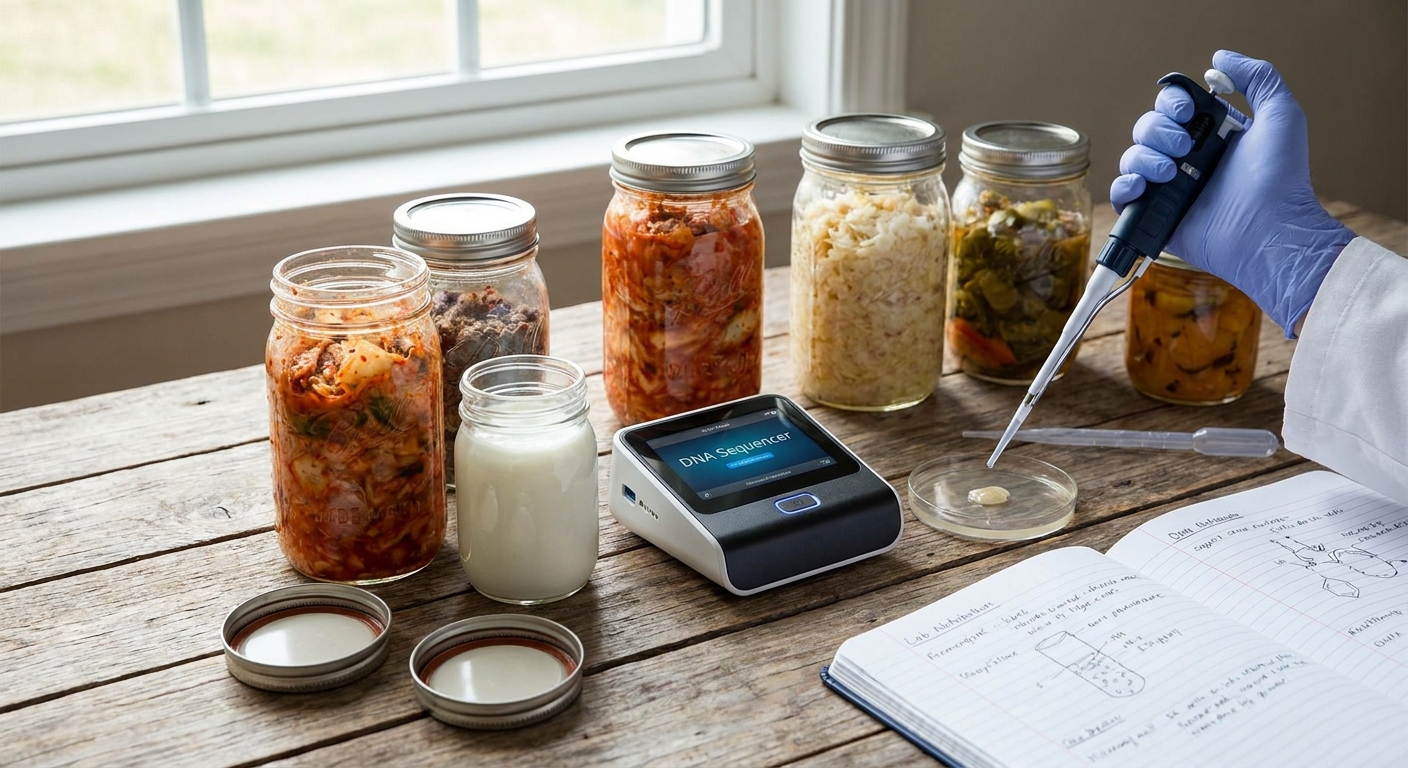
Fermented food research lives or dies on knowing exactly which microbes are driving a batch — and 16S rRNA sequencing for fermented food research is the fastest route to that answer, provided you pick the right primer set and pipeline for the job.
- V3-V4 Illumina amplicon sequencing is the safe pick for routine batch profiling of kimchi, idli batter, or kombucha consortia in 2026 — Buy.
- Full-length 16S long-read sequencing resolves the Lactobacillus complex down to species; short reads often cannot — Consider.
- Shotgun metagenomics adds functional gene data that 16s rrna sequencing for fermented food research alone cannot give you — Consider when strain tracking matters.
- Skipping mock-community spike-in controls is the most common mistake in fermented food 16S studies — it skews Gram-positive abundance enough to flip a conclusion.
Why this matters
Fermented food microbiomes are dense, fast-shifting, and taxonomically weird compared to soil or gut samples. A single idli batter fermentation can swing from a Leuconostoc-dominated early phase to a Lactiplantibacillus-dominated late phase in under 24 hours, and the wrong sequencing choice will blur that transition into noise.
The 2020 reclassification of the genus Lactobacillus into 25+ new genera (Zheng et al., International Journal of Systematic and Evolutionary Microbiology) means old reference databases still report genus calls that are now technically wrong for many food fermenters. If your pipeline has not been updated since then, your species table is out of date before you even open it.
Yaazh Xenomics runs 16S rRNA and shotgun metagenomic workflows as part of its microbiome testing service line alongside NGS, Sanger sequencing, and bioinformatics support for clinical, academic, and industrial partners — the same instrumentation and QC discipline used for pharma and clinical microbial work applies directly to food fermentation microbiota.
Who this is for
This guide is for food scientists, fermentation researchers, and QA teams at dairy, pickle, kombucha, and traditional fermented-food producers who need to characterize a starter culture, track a fermentation timeline, or defend a product's microbial safety profile with sequencing data rather than plate counts alone. It is also relevant to academic labs studying indigenous fermented foods (dosa batter, kanji, tempeh) where the microbiota is undercharacterized in public databases.
What to look for in 16S rRNA sequencing for fermented food research
Primer coverage matched to fermentation taxa
Most commercial 16S panels default to the V3-V4 region using 341F/805R primers, which covers roughly 460 base pairs and works well for common lactic acid bacteria. But some fermenters — certain Bacillus and Leuconostoc strains in particular — carry primer-binding site variants that under-amplify with generic primer sets, so confirm the panel has been validated against food-fermentation reference strains, not just gut isolates.
Resolution below the genus level
Short-read V3-V4 sequencing frequently cannot separate closely related Lactiplantibacillus, Levilactobacillus, and Lacticaseibacillus species — the genera that used to sit under one Lactobacillus umbrella before 2020. If your research question depends on which exact species is dominating a batch, you need read lengths closer to the full 1,500 bp 16S gene, not a 460 bp fragment.
Reference database curation
SILVA and Greengenes are built for broad microbial ecology, not fermented food specifically. A pipeline calibrated with food-fermentation reference genomes classifies ambiguous ASVs correctly far more often than one running stock databases straight out of the box — ask what reference set the lab uses before you commit samples.
Quantitative bias controls
PCR amplification bias is real and it is not random: Gram-positive cell walls resist lysis differently than Gram-negative ones, which skews relative abundance if extraction protocols are not standardized. A lab that spikes in a mock community with known composition per sequencing run gives you a way to correct for that bias after the fact — a lab that does not gives you a number you cannot trust.
Turnaround aligned to fermentation timelines
Fermentation studies often need time-course sampling — hour 0, hour 12, hour 24, day 3 — and batching all those samples into a single sequencing run matters more than raw speed. Confirm the lab can hold and batch a full time-course together rather than running samples in separate lots, which introduces batch effects that look like biological differences.
Bioinformatics transparency
ASV-based pipelines (DADA2) resolve single-nucleotide differences between near-identical sequences; older OTU clustering at 97% similarity lumps distinct fermenters together. For 2026-era fermented food work, ASV-based calling with explicit chimera checking is the baseline, not a premium option.
Plan your fermented food sequencing run
Scope primer selection, batch size, and turnaround before samples ship.
Top picks for 16S rRNA sequencing for fermented food research
V3-V4 Illumina amplicon sequencing — the safe pick. Covers the ~460 bp V3-V4 region at typical depths of 30,000-50,000 reads per sample, which is enough resolution for community-level shifts across a fermentation timeline. It is the standard choice for routine batch-to-batch comparison in 2026 and the cheapest entry point into 16s rrna sequencing for fermented food research. Buy for routine taxonomic profiling of kimchi, idli, or dairy ferment consortia.
Full-length 16S long-read sequencing — the high-resolution pick. Sequencing the full ~1,500 bp 16S gene on a long-read platform pushes taxonomic calls to species level and often closer to strain-level for well-studied lactic acid bacteria. It costs more per sample than V3-V4 amplicon work and needs a lab comfortable with long-read chemistry. Consider it when the research question hinges on distinguishing Lactiplantibacillus plantarum from a closely related species — V3-V4 data alone will not settle that argument.
Shotgun metagenomics — the wildcard. Beyond taxonomy, shotgun sequencing recovers functional genes: bacteriocin clusters, lactate dehydrogenase variants, and antibiotic resistance markers riding on starter culture plasmids. The same whole genome sequencing discipline used for bacterial outbreak investigation — strain-level lineage tracking from WGS data — applies directly to tracing a starter culture's identity across production lots. Depth requirements run higher, typically several gigabases per sample. Consider when a functional or strain-lineage question sits behind the taxonomy question.
Culture-based isolate confirmation — the low-cost check. For labs that already have plate isolates from a fermentation and just need identity confirmation rather than a full community profile, targeted Sanger sequencing of a single isolate is faster and cheaper than amplicon sequencing an entire sample. It also catches plasmid-borne traits — a probiotic starter strain screened for transferable resistance genes before commercial release is a real use case. Buy when the question is what is this one colony, not what is in this whole batch.
What to avoid
- Generic gut-microbiome pipelines with no food-specific curation. A pipeline validated on human stool samples misclassifies fermentation-relevant Leuconostoc and Weissella species at a noticeably higher rate than one calibrated with food reference strains.
- V3-V4-only data used to make species-level claims. The amplicon simply does not carry enough sequence information to separate some closely related fermenters — treat V3-V4 results as genus-level unless paired with full-length or shotgun confirmation.
- Skipping mock-community controls to save cost. It looks like a minor line-item cut, but without a known-composition control per run, you have no way to know whether a 15% shift in relative abundance is biology or extraction bias.
Verdict comparison
| Approach | Resolution | Relative cost | Best for | Verdict |
|---|---|---|---|---|
| V3-V4 Illumina amplicon | Genus, some species | Low | Routine batch/time-course profiling | Buy |
| Full-length 16S long-read | Species, near-strain | Medium-high | Resolving ambiguous close relatives | Consider |
| Shotgun metagenomics | Strain + function | High | Functional genes, lineage tracking | Consider |
| Sanger isolate confirmation | Single isolate ID | Low | Confirming a plate colony or plasmid trait | Buy |
For cost planning across these tiers, the general whole genome sequencing cost in India breakdown gives a useful baseline even when your project is amplicon-based rather than full-genome, since library prep and sequencing-run economics scale similarly.
FAQ
What is 16S rRNA sequencing for fermented food research used for?
It identifies and quantifies the bacterial community driving a fermentation — which species dominate at each stage, how a starter culture shifts over time, and whether contaminants are present. It is the standard tool in 2026 for characterizing kimchi, idli batter, dairy ferments, and kombucha SCOBYs without relying on plate culturing alone.
Is 16S rRNA sequencing better than shotgun metagenomics for fermented foods?
16S amplicon sequencing is cheaper and sufficient for genus-to-species community profiling, while shotgun metagenomics adds functional gene data and stronger strain resolution. Choose 16S for routine batch monitoring and shotgun when the question involves specific genes or strain lineage.
Which 16S region works best for fermented food microbiota?
V3-V4 (roughly 460 bp, amplified with 341F/805R primers) is the default and covers most lactic acid bacteria relevant to fermentation. Full-length 16S sequencing is preferred when species-level resolution within the Lactobacillus complex is required.
How many samples are needed for a fermentation time-course study?
Most published fermented food studies sample at 4-6 timepoints per batch with 2-3 biological replicates per timepoint, giving enough statistical power to detect a genuine microbial community shift. Batching all timepoints into a single sequencing run avoids introducing artificial batch effects.
Can 16S rRNA sequencing detect contamination in a starter culture?
Yes — unexpected ASVs outside the expected starter culture profile flag contamination, though confirming the exact contaminant species sometimes needs a follow-up Sanger read on an isolated colony. This is standard practice for QA teams validating starter culture purity before a production run.
Why did my Lactobacillus results change between older and 2026 studies?
The genus Lactobacillus was reclassified into 25+ new genera in 2020 (Zheng et al., IJSEM), so older reference databases and newer ones assign different genus names to the same organism. Studies published after 2020 using updated databases show genus names like Lactiplantibacillus or Levilactobacillus instead of Lactobacillus.
Do I need mock community controls for fermented food 16S sequencing?
Yes — PCR and extraction bias affects Gram-positive and Gram-negative organisms differently, and a mock community with known composition run alongside your samples is the only way to correct for that bias. Without it, relative abundance numbers carry an unquantified error.
How does 16S sequencing compare to whole genome sequencing for starter culture QC?
16S sequencing profiles the whole community; whole genome sequencing characterizes a single isolate down to the strain level, including plasmid-borne traits. Use 16S to survey the batch and whole genome or Sanger sequencing to confirm the identity of a specific isolate.
One last thing
Most fermented food 16S studies still cite reference taxonomies from before the 2020 Lactobacillus genus split — if your literature review or your own past project data uses the old genus name, cross-check it against a 2026-current database before drawing conclusions, because the organism did not change but its name and taxonomic neighbors did.