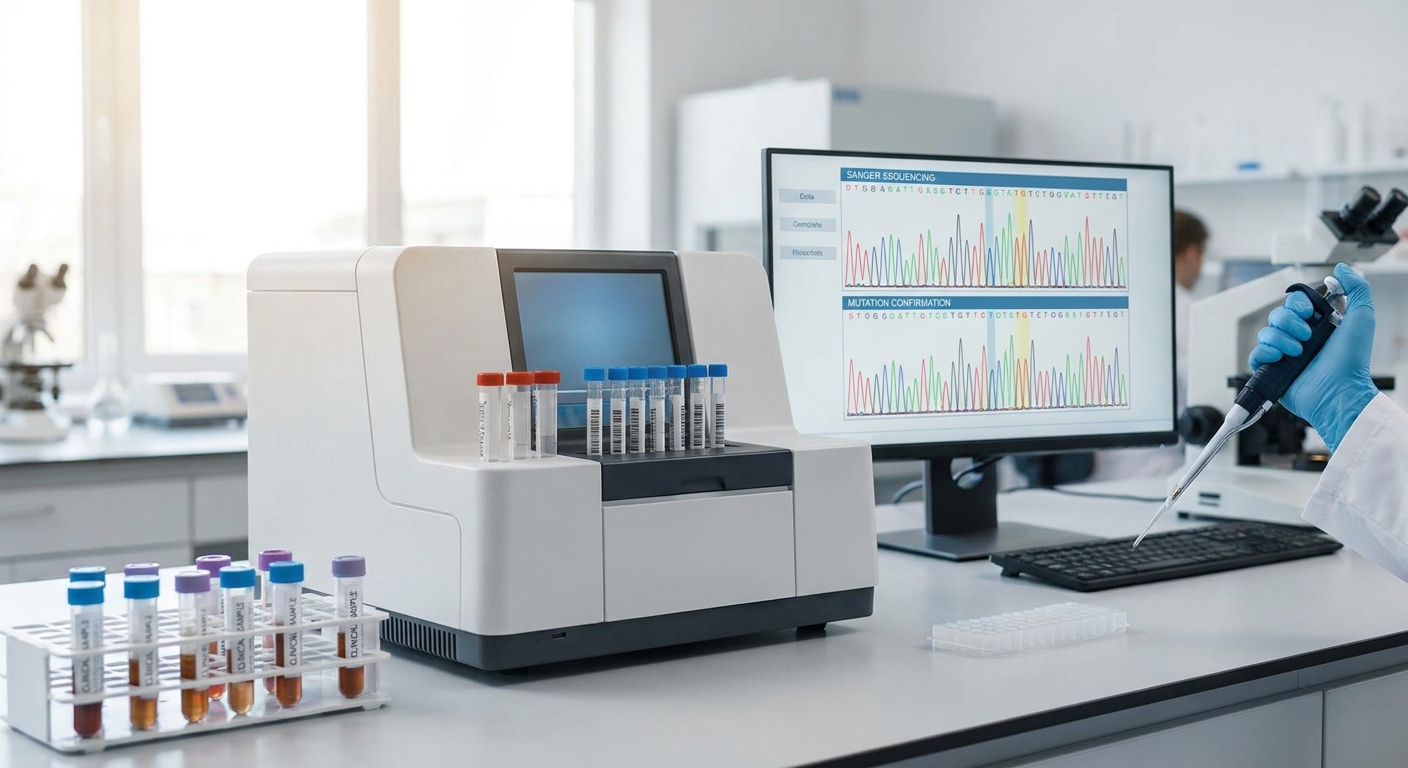
Sanger sequencing for mutation confirmation closes the loop on an NGS variant call before it reaches a clinical report, a pediatric diagnosis, or a biomarker decision in 2026.
- Sanger sequencing for mutation confirmation validates NGS variant calls at 99.9% base accuracy — Buy for any clinically reportable variant in 2026.
- Bidirectional Sanger reads catch strand artifacts single-direction reads miss; one-direction confirmation is a Skip for clinical reporting.
- Pair Sanger confirmation with hereditary cancer NGS panels or pediatric exome sequencing instead of running it as a standalone discovery tool.
- ISO 9001:2015 certified reporting chains matter more than raw speed once a confirmed variant feeds a clinical or regulatory report.
Why Sanger confirmation still matters in 2026
NGS panels and exome runs call thousands of variants in a single pass, but a false positive buried in a homopolymer stretch, a low-coverage exon, or a repetitive region can send a wrong diagnosis to a patient or a wrong inclusion criterion into a trial file. Sanger sequencing for mutation confirmation exists to catch exactly that failure mode before a report goes out the door.
At Yaazh Xenomics, the confirmation workflow runs on the same ISO 9001:2015 certified process used across the lab's NGS, exome, and clinical genomics services, with base-calling accuracy quoted at 99.9% on the confirmed base. That single number is the whole argument for running a second, orthogonal method instead of trusting one NGS caller on a variant that changes someone's treatment plan.
The cost of skipping confirmation is not abstract. A single unconfirmed variant reported to a family, or entered into a pharma trial's inclusion criteria, in 2026 carries downstream costs — repeat testing, delayed treatment decisions, or a retracted result — that dwarf the price of one Sanger reaction run against the exact amplicon the NGS panel flagged.
Who this is for
This guide is for clinical genetics labs, genetic counselors, oncology diagnostic teams, and biotech or pharma QA groups that already ran NGS or exome sequencing and now need one variant confirmed before it goes into a patient report, a regulatory file, or a publication. It is not for teams looking to discover new variants from scratch — that job belongs to the original NGS panel or exome run, not to a targeted confirmation step. If the question is "is this specific call real," Sanger sequencing for mutation confirmation is the right tool; if the question is "what variants exist in this sample," it is the wrong one.
What to look for in Sanger sequencing for mutation confirmation
1. Coverage on the exact confirmation amplicon
Sanger sequencing for mutation confirmation only works if the primer set actually spans the base the NGS panel flagged, not a nearby region that looks close enough. Ask for the amplicon design and the exact reference coordinates before the sample goes in, not after the trace comes back and the coordinates don't line up.
2. Base-calling accuracy and Phred quality cutoffs
A 99.9% base accuracy claim only means something if the lab applies a hard Phred quality cutoff, commonly Q20 or higher, before calling a base confirmed. Anything looser turns a confirmation report into a guess dressed up as a second opinion.
3. Bidirectional sequencing, not a single pass
A forward-only read cannot rule out a strand-specific artifact from PCR or a polymerase slippage error. Clinically reportable variants need both forward and reverse traces agreeing on the same base call in 2026 — one direction is a shortcut, not a confirmation.
4. Turnaround matched to the decision window
A pediatric diagnostic team waiting on one confirmed variant needs the result before the next clinic visit, not before the next quarterly review. Match the confirmation turnaround to the actual clinical or trial deadline instead of accepting whatever queue the lab defaults to.
5. An ISO-certified reporting chain
An ISO 9001:2015 certified process means the confirmed variant call, the trace file, and the final report are traceable end to end. A regulatory submission or a disputed de novo variant case will eventually ask for that chain of custody, and a lab without it cannot produce one after the fact.
6. Fit with the upstream NGS or exome call
The confirmation lab needs the exact reference build, transcript, and variant nomenclature the discovery lab used. A mismatch here produces a second variant call that argues with the first one instead of confirming it, which defeats the entire point of running Sanger in the first place.
“A single forward-only Sanger read cannot rule out a strand-specific artifact — that call is not confirmed yet.”
Where Sanger confirmation fits by clinical scenario
The right confirmation pathway depends on what produced the candidate variant in the first place. Four scenarios cover most of the clinical and research volume moving through a genomics lab in 2026.
Hereditary cancer variant confirmation — the standard confirmation loop
Hereditary cancer NGS panels flag germline BRCA-type and mismatch-repair variants that go straight into a patient-facing report, so every reportable call needs a second method before it ships. Sanger sequencing for mutation confirmation on the flagged amplicon, run at 99.9% base accuracy, is the standard second read paired with NGS panel testing for hereditary cancer screening. Verdict: Buy — skip it only if the panel already ran orthogonal duplicate sequencing on the same variant.
Pediatric exome findings — the diagnostic finisher
A pediatric exome run can surface a single candidate variant that decides a diagnosis, a treatment path, and a family's next pregnancy decision. Bidirectional Sanger confirmation on that one exon, paired with exome sequencing for pediatric genetic disorders, turns a candidate call into a reportable one. Verdict: Buy for any de novo or compound heterozygous call; Skip for variants already flagged as common population polymorphisms in reference databases.
Consanguineous family exomes — the homozygosity double-check
Consanguineous pedigrees produce long runs of homozygosity where a real pathogenic variant sits next to dozens of benign homozygous calls from shared ancestry. Confirming the single candidate through Sanger sequencing alongside whole exome sequencing for consanguineous families rules out a mapping artifact before the family gets a result they will act on. Verdict: Buy.
Rare disease exome calls — the last-mile clarity pick
A rare disease workup often ends on one variant of uncertain significance that needs to move to "likely pathogenic" before anyone acts on it. Sanger confirmation run against whole exome sequencing for rare disease diagnosis closes that gap with an independent trace rather than a second NGS pass on the same platform. Verdict: Buy — Hold if the variant sits in a segmental duplication region where primer design needs another round first.
Comparison across scenarios
| Scenario | Confirmation Focus | Read Direction | Turnaround Priority | Verdict |
|---|---|---|---|---|
| Hereditary cancer panel | Single flagged germline variant | Bidirectional | Fast, pre-report | Buy |
| Pediatric exome | De novo or compound het variant | Bidirectional | Fast, pre-clinic visit | Buy |
| Consanguineous family exome | Homozygous candidate vs. artifact | Bidirectional | Moderate | Buy |
| Rare disease exome | VUS to likely pathogenic | Bidirectional | Moderate | Buy / Hold |
What to avoid
- Running Sanger as a discovery tool. Sanger sequencing for mutation confirmation is built to check one known position, not to scan an exome — using it for discovery burns budget and misses everything outside the primer window.
- Single-direction reads on reportable variants. A forward-only trace that "looks clean" is not a confirmed call; without the reverse read, a strand-specific PCR error can pass straight into a patient or trial report.
- Skipping primer redesign in repetitive regions. A GC-rich or repeat-heavy locus that worked for the NGS panel can still drop out in a standard Sanger reaction — the confirmation lab needs to redesign, not reuse, the primer set.
Confirm Your NGS Variant Call
ISO 9001:2015 certified Sanger confirmation for clinical and research variant calls.
FAQ
What is Sanger sequencing for mutation confirmation?
Sanger sequencing for mutation confirmation is a targeted, single-locus sequencing method used to independently verify a variant already flagged by NGS or exome sequencing. It reads the exact base position from both strands and produces a confirmed call before that variant reaches a clinical or research report.
Why confirm an NGS variant with Sanger sequencing instead of trusting the NGS call?
NGS callers can misread variants in low-coverage, homopolymer, or GC-rich regions, and a false positive at that stage becomes a wrong diagnosis downstream. Sanger sequencing runs on a different chemistry and error profile, so it catches mistakes the original NGS pipeline cannot see on its own.
How long does Sanger confirmation take after an NGS variant call in 2026?
Turnaround depends on primer design complexity and sample volume, and it runs faster than a full exome or panel workup since only one locus needs sequencing. Labs typically schedule confirmation runs to land before the next clinical review rather than as an open-ended queue item.
Is Sanger sequencing more accurate than NGS for a single variant?
For one targeted position, Sanger sequencing reaches around 99.9% base accuracy and remains the reference method regulators expect for confirming a reportable call. NGS is stronger for scanning thousands of positions at once, but a single confirmed base is Sanger's strength.
Does every NGS-detected variant need Sanger confirmation?
Not every variant needs it — high-confidence calls with strong coverage and quality scores in well-characterized regions sometimes skip confirmation depending on lab policy. Variants that will change a diagnosis, a treatment plan, or a regulatory submission should get confirmed regardless of the initial confidence score.
What's the difference between Sanger confirmation and whole exome sequencing?
Whole exome sequencing scans the protein-coding regions of the genome to discover variants, while Sanger confirmation checks one already-flagged position to verify it is real. The two are sequential steps in the same workflow, not competing methods.
How much does Sanger sequencing cost for mutation confirmation?
Cost depends on the number of amplicons, the primer design complexity, and the gene region involved, so figures vary case by case. Confirming a single variant still costs a fraction of a full panel or exome re-run, which is why it stays standard practice in 2026.
Can Sanger sequencing confirm variants in consanguineous family testing?
Yes — Sanger confirmation is the standard way to distinguish a real homozygous pathogenic variant from a mapping artifact in consanguineous pedigrees. It runs alongside whole exome sequencing for consanguineous families as the verification step before a result reaches the family.
One last thing
The number that gets skipped most often isn't accuracy — it's direction. A lab that only runs a forward read on a confirmation sample is doing half the job, and a genuinely confirmed variant needs both strands agreeing on the same base call. Before approving any Sanger sequencing for mutation confirmation vendor in 2026, ask for the bidirectional trace file, not just the summary report. If a lab won't produce both traces on request, that is the fastest way to spot a shortcut before it becomes a wrong result on a patient chart.